
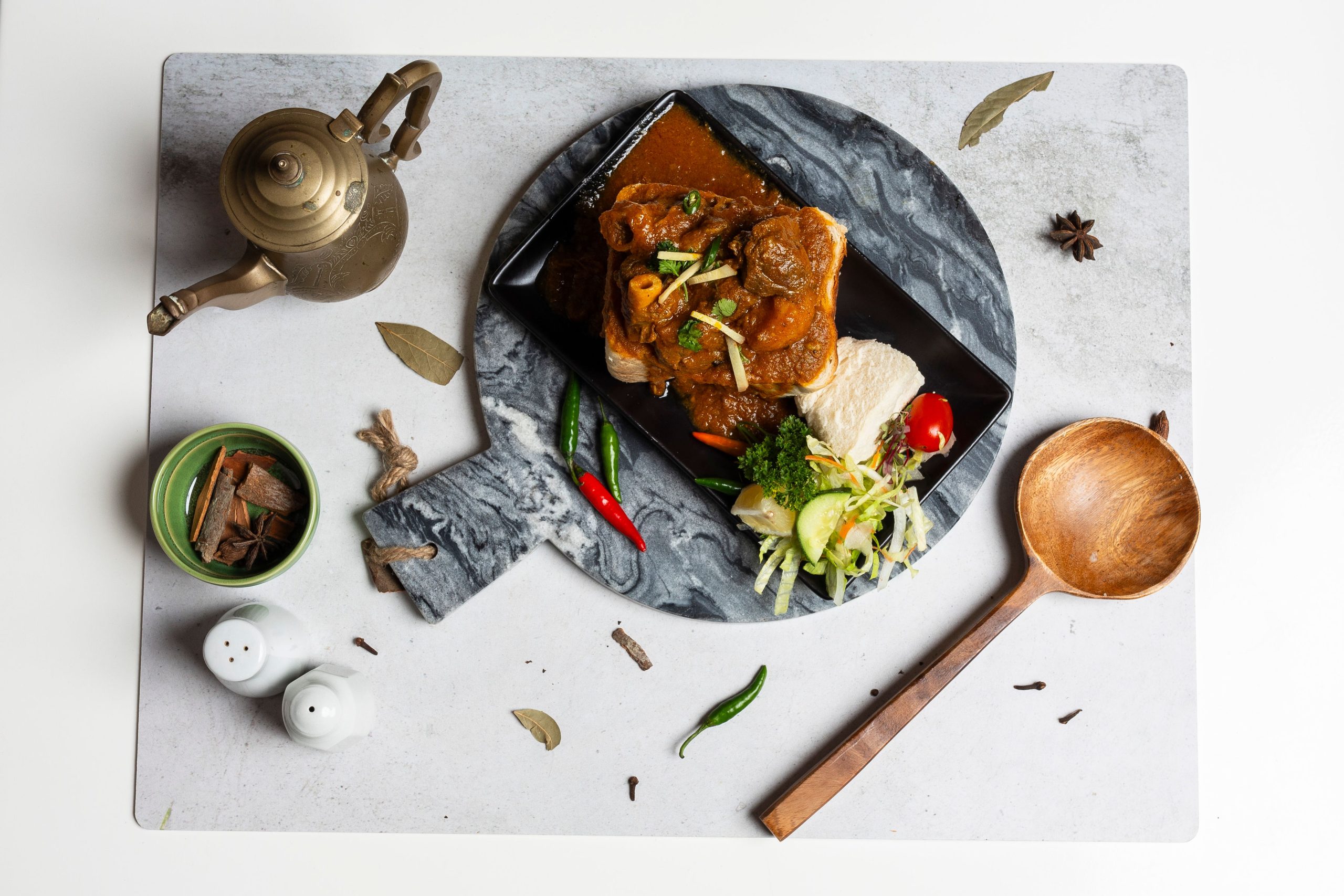
A bunny chow is a hollowed out loaf of bread filled with curry. This dish was born right here in Durban, and we are proud to serve it in the city that gave it to the world. Ours comes packed with slow cooked mutton curry and enough gravy to soak right through the bread.
The dish
If you have never had one, here is the simple version. We take a loaf of white bread, cut it in half or in quarters, and scoop out the soft middle. That leaves you with a little bread bowl. We fill it with hot curry, then put the scooped out piece of bread back on top like a lid. You eat the whole thing with your hands. No plate, no fork, no spoon.
The bread is the bowl and the bread is the meal. As you eat, you pull off pieces of the loaf and dip them into the curry that has soaked into the sides. By the time you reach the bottom, the bread there is soft and full of gravy, and a lot of people will tell you that is the best part.
So why should you care about a piece of bread filled with curry? Because once you understand where it came from and why it was made this way, you taste it differently. This is one of the few dishes that was truly invented in South Africa, and the story behind it is worth knowing before you take your first bite.
When a bunny lands in front of you, the steam is already rising off the curry and the gravy is starting to stain the bread a deep brown. You pick it up with both hands. This is street food the way it was always meant to be eaten.
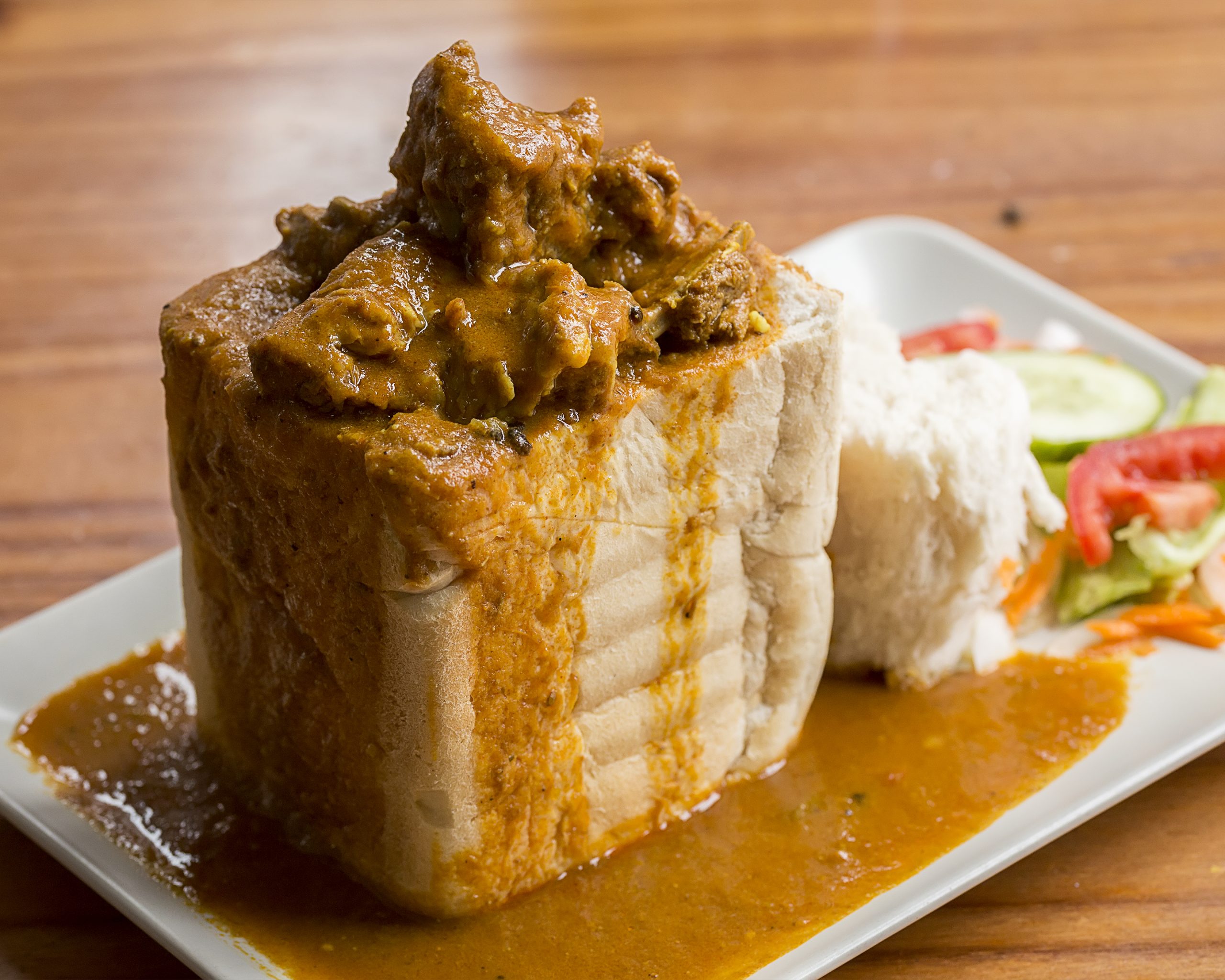
Mutton Bunny Chow - slow cooked curry in a hollowed loaf - at Kebabish Halaal Indian Restaurant, Florida Road
The history
The bunny chow was born in Durban. Most people agree it started in the Indian Muslim community around the Grey Street area, which is now Dr Yusuf Dadoo Street, somewhere in the middle of the last century. This was during the apartheid years, when the law decided where people of colour could go, where they could sit, and where they could eat.
Black and Indian workers were kept out of many cafes and restaurants. They could buy food, but often they could not sit down inside to eat it. They needed something they could carry away and eat with their hands, somewhere else, on a break, on the move. The shopkeepers around Grey Street came up with the answer using what they already had on the counter, a loaf of bread and a pot of curry.
That is the heart of it. A meal that did not need a table you were not allowed to use. A meal you could carry in your hands and share with the people next to you. From those small shops it spread across Durban, and over time it became one of the things this city is known for all over the world.
The name
People are often surprised that there is no rabbit anywhere near a bunny chow. The name has nothing to do with the animal. The story most people in Durban believe is that it comes from the word "bania". The bania were a community of Indian merchants and shopkeepers, and many of the traders who first sold the dish came from that background. "Bania chow" softened into "bunny chow" over the years, and the name stuck.
There are a few other ideas floating around about the name, the way there always are with old street food. Some say "chow" simply comes from the everyday slang for food. What everyone does agree on is that the dish came from Indian shopkeepers feeding working people, and the name carries that history with it whether you think about it or not.
More than a meal
It helps to remember what the bunny chow really was for the people who first ate it. It was a clever answer to an unfair rule. The bread did the job of a plate and a takeaway box at the same time, so a worker could grab one in the morning and eat it later with nothing but his hands.
There is something bigger in that too. When a community is pushed to the edges and told where it can and cannot go, feeding each other becomes a quiet way of holding together. The shops around Grey Street were not only selling lunch. They were keeping people fed and keeping a community connected during years that were built to pull it apart. Food carried that weight, and the bunny chow is one of the clearest examples of it anywhere in the country.
A simple loaf of bread became a way for ordinary people to look after each other when the system would not. That is why we treat this dish with respect, and not as a gimmick.
The community
To understand the bunny, you have to understand the people who made it. Indians came to the Durban area in two main waves. The first came as indentured labourers from the 1860s onwards, brought in to work the sugar cane fields of what was then Natal. The second came as traders and merchants, many of them Muslim, who set up shops and businesses in the growing city.
A lot of those traders settled around Grey Street, and over time that part of Durban grew into a busy hub of shops, cafes and family businesses, all gathered around the Grey Street Mosque. It became a place with its own rhythm, its own food, and its own way of life. The bunny chow grew straight out of that world. It came from real shopkeepers feeding real workers, day after day, in the middle of a hard time.
Why this dish means something to us
We are a Pakistani Muslim family, and the bunny chow is not our invention. We want to be clear and honest about that. It belongs to Durban and to the Indian Muslim community that created it. We serve it because we love it, and because we live and cook in this city, and a Durban restaurant that ignores the bunny chow is missing something important.
There is also a thread that ties the two stories together. The Indian Muslim families who came to Durban built a home and held onto who they were through their food, far from where their families started. Our own family was scattered by the Partition of 1947 and had to rebuild in new cities, and we held onto ourselves the same way, through the food we cooked. When you sit with it, the bunny chow and the food we grew up on are telling the same kind of story. Food keeping people together when everything else is moving.
So when we put a bunny on the menu, it is our way of saying thank you to the city that took us in. We serve it with a curry that is worth the bread it fills.
Why the bread works
The plain white loaf is not a lazy choice. It is the right choice, and there is a reason for it. The crust on the outside is firm enough to hold the shape of the bowl, so it keeps the curry in and does not fall apart in your hands. The soft crumb on the inside acts like a sponge and slowly drinks up the gravy as you eat.
That slow soaking is the whole trick. A fresh bunny gives you dry, fluffy bread on top and rich, curry soaked bread at the bottom, so every few bites taste a little different. The longer it sits, the deeper the gravy travels up the sides.
How to eat one properly
On the plate
The curry is where we put our care. Our mutton is slow cooked on the bone until the meat gives way easily and the gravy turns thick and deep. We build the spice the way our family has always done it, so it has real heat and a full, layered flavour rather than one flat note of chilli. That gravy is what soaks into the bread, so it has to be right.
We fill a quarter or a half loaf depending on how hungry you are, top it with the scooped out bread, and send it out hot. If mutton is not your thing, we also do the bunny with chicken, with our grilled kebab, and in bean and vegetable versions for anyone who does not eat meat. You can see them all on the full menu, and they pair well with our charcoal grilled chicken tikka if you are ordering for a few people.
Come in
You will find us at 49 Florida Road, right in the middle of the Florida Road restaurant strip, with our other branches at North Beach and Overport. You can sit in, take it away, or get it delivered. A bunny travels really well, since the bread is built to hold the curry, so it stays in good shape on the way home.
If you are ordering a few bunnies for a group, give the kitchen a quick call ahead on 031 303 7806 so we can have them ready for you when you arrive.
Good to know
Yes. Kebabish is Halaal Certified by The Halaal Foundation of South Africa (THFSA), so every bunny we serve is fully halaal.
No. The name most likely comes from the word "bania", the Indian merchant community that first sold the dish in Durban. There is no rabbit involved at all.
It is the size of the loaf we fill. A quarter is a good lunch for most people. A half is the proper hungry portion, with more bread and more curry.
We do mutton, chicken, and grilled kebab bunnies, along with bean and vegetable versions for anyone who does not eat meat. See the full menu for prices.
It has a good level of heat and a full, deep flavour. If you would like it milder, let us know when you order and we can adjust it for you.
Yes. You can dine in, take it away, or order delivery. The bread holds the curry well, so a bunny travels nicely and is still good by the time you get home.
With your hands. Pull off the bread lid first and dip it in the curry, then break off pieces from the sides to scoop up the meat and gravy, and save the soft soaked bottom for last.
49 Florida Road, Berea, Durban, 4001, in the middle of the Florida Road restaurant strip. We also have branches at North Beach and Overport.
Yes. Give us a call on 031 303 7806 with a bit of notice and we can have a batch of bunnies ready for your group.
Dine in on Florida Road, order online for delivery, or give us a call. The curry is on all day.
Order Online View Full Menu