

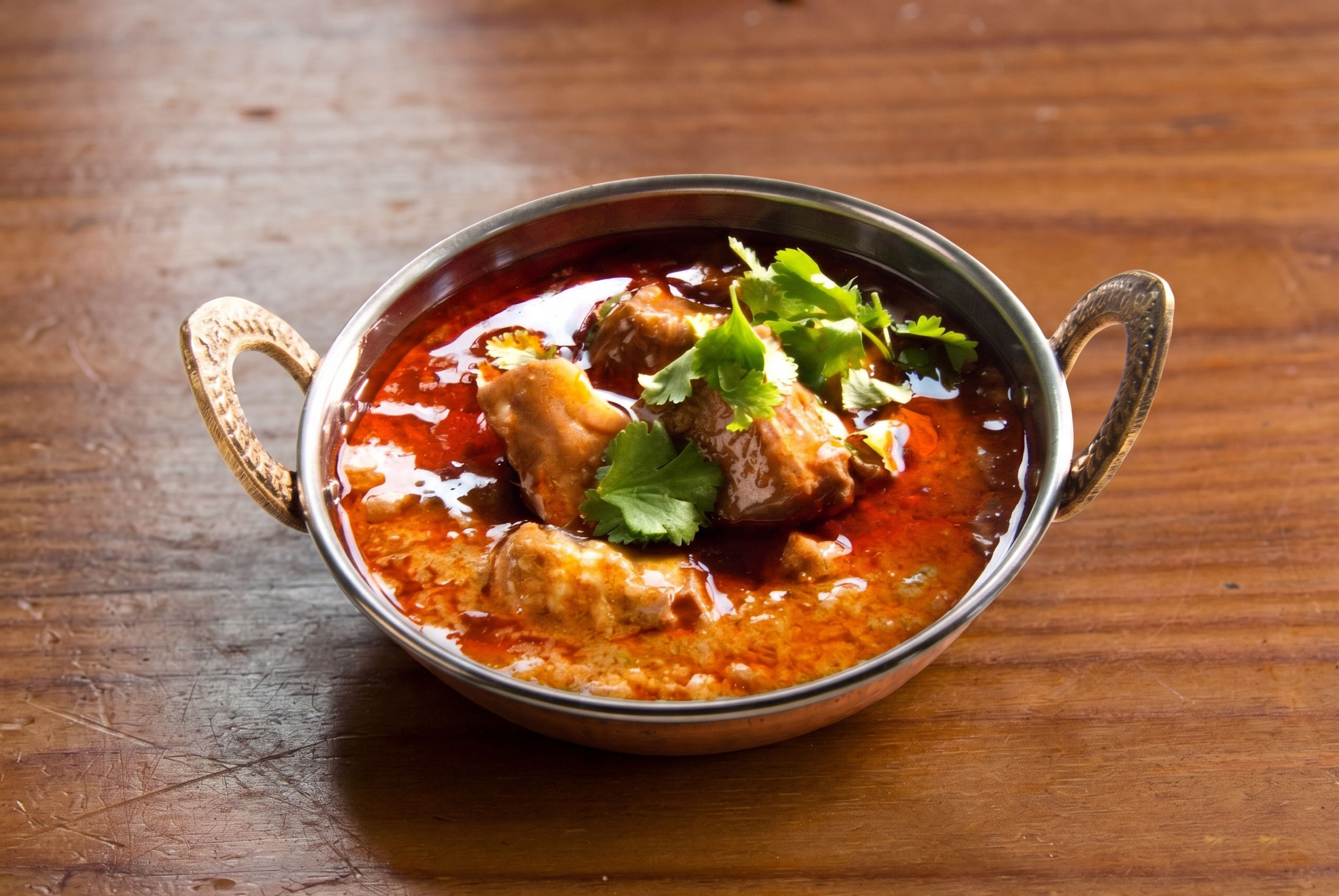
Nihari is a deep, slow cooked stew of lamb on the bone, simmered for hours until the meat falls apart and the gravy turns thick and rich. It started in the royal kitchens of Delhi, India and travelled to Pakistan with our families. This is a dish that belongs to us, and we cook it the way it has always been done.
The dish
Nihari is a slow cooked meat stew. We take lamb on the bone, cover it in a deep spice blend, and let it cook on a low fire for hours until two things happen. The meat goes so soft that it slides off the bone on its own, and the gravy turns thick, glossy and full bodied.
That thick gravy is the whole point of nihari. It is not a thin curry that you spoon over rice. It is rich enough to coat the back of a spoon, and you eat it by tearing off pieces of warm bread and dragging them through it. For a lot of Pakistani families, this is the dish you save for a special morning, and one taste tells you why.
You can smell a good nihari before it reaches the table. The lamb has been cooking long enough to give everything up to the pot. When you push a piece of naan into that gravy, it holds on. This is the dish we grew up on, made the way it should be.
Mutton Nihari - slow cooked lamb shank in a thick spiced gravy - at Kebabish Halaal Indian Restaurant, Florida Road
The history
Nihari was born in the kitchens of the Mughal emperors in Delhi, India, inside the walls of the Red Fort. The royal cooks would set it to cook overnight on a low fire, so that by morning the meat had fallen apart and the gravy had pulled together. It was carried out at dawn and served to the emperor after the Fajr prayer, the first prayer of the day.
When the Mughal Empire faded, the dish came down out of the palace and onto the street. The cooks who once worked for kings opened their own shops, and nihari became a morning meal for working people, sold from early stalls before the day began. A food that started as a royal breakfast turned into one of the most loved street foods of the whole region, and it kept its dawn habit the entire way.
The meaning
The name comes from the Arabic word "nahar", which means day or morning. The dish got that name because it was the meal eaten at the start of the day, the one that broke the long fast of the night after the dawn prayer. From the very beginning, nihari was tied to the rhythm of Muslim daily life.
That link is still alive today. In Lahore and Karachi, a plate of nihari on a Friday morning is a tradition that families keep week after week. It also has a special place in Ramadan, when a rich, slow cooked meal is exactly what people want at the table. So when we serve it, we are serving more than a stew. We are serving something that has sat at the centre of Muslim family life for a very long time.
The spices
Nihari uses its own spice blend, and it leans on dried, warm spices rather than fresh herbs. The blend pulls together fennel, dried ginger, black pepper, cardamom, cloves, mace and nutmeg, among others.
This is the Persian and Mughal way of cooking, where you build a deep flavour slowly instead of reaching for fresh aromatics at the end. The spices give up their flavour little by little over the long cook, and the gravy soaks all of it in. With nihari, time itself is the main ingredient. You cannot rush this flavour into being. You have to wait for it.
The journey
In 1947, the Partition split the region in two and sent millions of Muslim families across the new border into Pakistan. Many of them came from Delhi, India, carrying their recipes with them. Nihari crossed over from India in those years and put down new roots, first in Lahore and then in Karachi.
In the cities that filled up with families from Delhi and the Punjab, nihari became part of the local identity. It turned into one of the foods that says home to a Pakistani Muslim. The shops that sell it have been running for generations, and the morning queue outside a good nihari place is still a normal sight. The dish that once travelled out of a palace had found a brand new home, and the people who carried it never let go of it.
Why this dish is ours
Our family is Arain, with roots in Amritsar before Partition and then in Faisalabad after it. Those cities sit right next to Lahore, in the same part of the world where nihari became part of everyday Muslim life. This is not a dish we picked up from a menu somewhere and decided to copy.
It comes from the same kitchens and the same streets our family comes from. The smell of it is tied to our own memories of home and family mornings. When we cook nihari at Kebabish, we are cooking something that sits inside our own history, our faith and the way we were raised. That is a different thing from putting a trendy dish on the board, and we hope you can taste the difference.
We do not serve nihari because it is popular. We serve it because it belongs to us. It is made with the bones, the time and the care the dish has always asked for.
The method
Nihari is built around meat on the bone, like shank and marrow bones, and that choice does all the heavy lifting in the pot. The long slow cook is what turns those tough, bony cuts into something soft and rich. Here is what is happening while it simmers.
A quick cook can never do this. The texture and the richness only come from bone, marrow and patience. That is the deal with nihari, and there is no way around it.
On the plate
A bowl of nihari is rich, so the things we serve on top are there to balance it out, and each one does its own job. Fresh ginger strips give a clean, sharp lift. Sliced green chillies add a fresh heat that sits on top of the deep spice. Chopped coriander brings a bit of garden freshness. A squeeze of lemon cuts straight through the fat, and fried onions add a sweet, crisp edge.
You add these to your own taste, a little at a time, so every spoonful can be a bit different. We serve nihari the traditional way, with warm naan or sheermal on the side for scooping up the gravy. It is not a dish you eat with rice. The whole pleasure of it is tearing off bread and dragging it through that thick gravy until the bowl is clean.
Come in
You will find us at 49 Florida Road, in the middle of the Florida Road restaurant strip, with our other branches at North Beach and Overport. You can sit in, take it away, or order delivery. Nihari holds up really well in a takeaway box, since the slow cook has already locked the flavour into the meat and the gravy, so it loses nothing on the way home.
It also goes really well alongside our other slow cooked dishes if you are feeding a few people, like a Pakistani style chicken biryani. For larger orders, give the kitchen a call ahead on 031 303 7806 so we can have it ready when you want it, and you can always check the full menu for everything else we cook.
Good to know
Yes. Kebabish is Halaal Certified by The Halaal Foundation of South Africa (THFSA), so the nihari is fully halaal.
Our Mutton Nihari is made with slow cooked lamb shank on the bone. Cooking it on the bone is what gives the gravy its thick body and rich flavour.
It is deep, warm and rich, with soft meat and a thick spiced gravy. The flavour comes from a slow cook and a blend of warm spices like fennel, dried ginger, cardamom and black pepper.
It has a warm, full heat rather than a sharp one. The fresh chilli and ginger on top let you push it up to your own taste. If you would like it milder, let us know when you order.
We serve it the traditional way, with warm naan to scoop up the gravy, plus fresh ginger, green chilli, coriander, fried onions and lemon on top. It is eaten with bread, not rice.
It takes hours of slow cooking and good cuts of lamb on the bone to get the right texture and gravy. The time and the meat are what you are paying for, and it is worth it.
Yes. You can dine in, take it away, or order delivery. Nihari travels really well, since the slow cook locks the flavour in, so it is still rich by the time you get home.
49 Florida Road, Berea, Durban, 4001, in the middle of the Florida Road restaurant strip. We also have branches at North Beach and Overport.
Nihari is on our menu, and because it is slow cooked we sometimes sell out on busy days. If you want to be sure, give us a call on 031 303 7806 before you come in.
Dine in on Florida Road, order online for delivery, or give us a call. The pot has been going since morning.
Order Online View Full Menu